The Positive Crankcase Ventilation (PCV) valve is a forgotten component on the engine that deserves a little more attention that it gets. Its purpose is to collect engine blow-by and distribute it back into the engine for re-burning. Blow-by is caused by combustion and enters the crankcase via the rings when the rings start to lose tension against the bore and can't hold the combustion pressure above the rings. There is still blow-by on a new engine although it is not very noticeable but is detectable on an exhaust gas analyser as a Hydrocarbon (HC). This process allows some of the unburnt fuel and combustion by products to enter the crankcase. If allowed to remain in the crankcase it will mix with the oil and contaminate it over time thereby reducing the engine oil life and cause other internal problems.
Connection to the correct place into the intake manifold is crucial for the correct distribution of these vapours back into the engine. The blow-by must be distributed evenly among all the cylinders so the best location for the entry point is into the middle of the intake runner directly under the carburettor. An example below of a 6 cylinder Holden engine with the PCV incorrectly fitted in the left photo. The right photo shows its correct location.
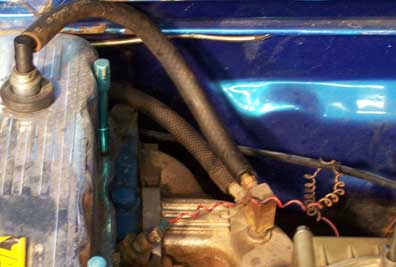
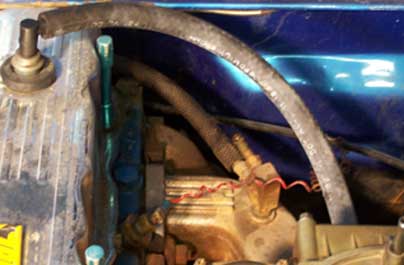
Some carbies have an inlet tube for the PCV pipe and some manifolds also have a tube for this purpose placed directly under the carby. When dealing with multiple carbies the PCV hose is cut and 'T' or 'Y' pieces are used to make extra entry points according to how the manifold is designed and how many carbs there are. ie. Torana GTR XU-1 the hose is split in two and the hoses run into the intake manifold between the carbs, 1&2 and 2&3. Sometimes the occasion may call for an entry into each runner which requires the hose to be split twice. In a lot of cases with performance engines, the PCV may be removed.
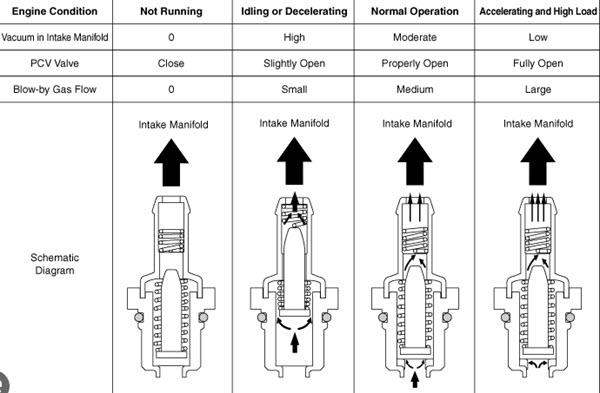
The above image shows how flow is affected by vacuum so with regards to engine tuning, the PCV must be the right part and working correctly. The carby is jetted to compensate for the PCV valve. Unfortunately as the engine wears and creates more blow-by, the engine begins to run a little on the rich side. The idle mixture screws can be adjusted to lean the mixture off at idle but to compensate for cruising and power you will be required to change main jets. However this is not done on a regular basis because of cost and it is considered in most cases unnecessary on a stock engine. It is usually left alone until the fumes are that bad that an engine o/haul is the best option.
When dealing with a performance street engine it does become a little tricky. As one would realise the vacuum in a mild or wild street engine varies significantly from a standard engine. This of course changes the characteristics of the flow through the PCV valve. Unfortunately I have never seen flow rates attributed to a PCV valve. If there was such a thing then a PCV valve could be chosen to suit the engine operating conditions. The choice is to work with what you have or remove the valve entirely and jet the carby accordingly. Although we have had the PCV system since around 1964 it was not made mantadory until 1972 under the emission rule 27. I know it is illegal to remove the system after a 1972 production car but am not certain if this can be done if your vehicle is pre 1972 and was fitted with the PCV system from factory.
